Hive inspections:
Went into the top-bar hives again today. I came later in the morning while the others were doing hive inspections. I saw some pretty cool things! I saw a bee pulling a newborn out of the cell. I saw a bee that was white becuase it was covered in coconut pollen. I like pulling that bars apart and seeing the bees all strung together. There was one hive that was producing capped honey and had plenty of food. Most of the others had barely enough food and will need to be fed. I am going to learn about how they do the feeding a different day.
Hive location:
They were thinking of physically switching two of the hive locations with each other. It seems difficult to move them becuase they are five feet long. Apparently others do it with a truck bed (from the Les Crowder book). It will be interesting once we actually do it.
Nuke prep:
Taylor, Kwao and I went back in to check out the Langstroth hives (with more protection on). We were looking for bars with food on them to put into another weaker top-bar. We selected three bars and put them in the top box for when we do the transfer later. The Langstroth hives (there are 5 of them) are there for breeding. Most of the frames do not have foundation, and some have bars that will go into top-bar hives later. I am looking forward to learning more about the process of transferring bars. As a part of the usual inspection of each frame, we take a knife to cut off irregular comb that is in the way as well as unnecessary queen cells. We had to go in early becuase it got way too hot.
Transferring:
Agape and I went in again after lunch and took the three bars to transfer into the breeding nuke. The hive was a different design and slightly wider; the top bars barely fit.
Showing posts with label honey. Show all posts
Showing posts with label honey. Show all posts
Monday, July 15, 2013

Friday, July 12, 2013
Day 3: Pollen traps


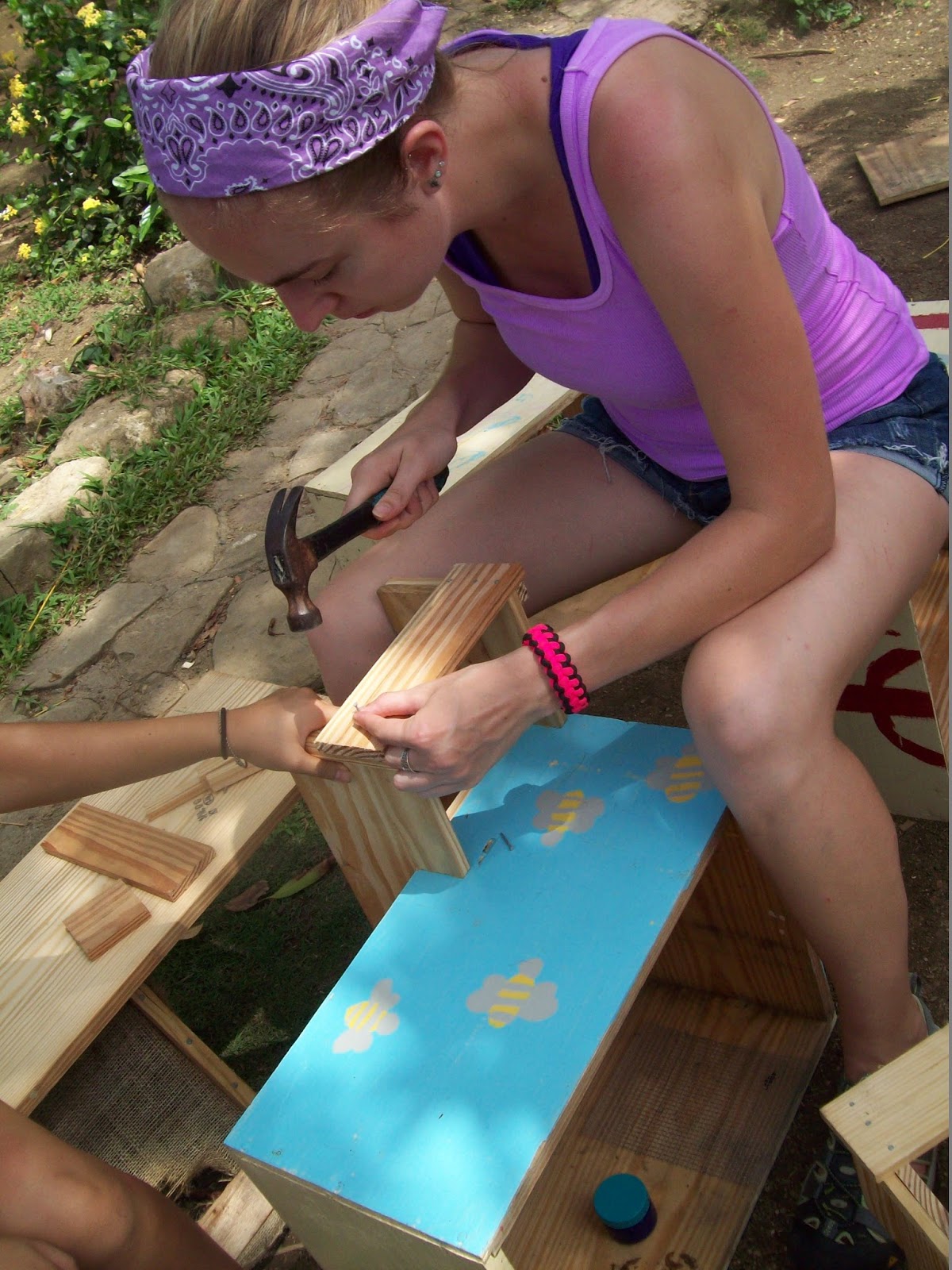

The finished product:

Day 3: Into the top-bar hives, bees!
This morning Agape and I went into the hives so that she could show me the inside. I wore a half suit and veil, gloves, and was in shorts. I didn't really need the gloves and they just got in the way, actually.
Agape and I talked about the benefits of top-bar and I asked lots of questions. Hopefully I can remember the good points.
Looking in the hive:
We went through each hive and she showed me how to take the top off, move the bars over to get to the bees, and then check each bar. Basically, you lift each bar and see if there are eggs, larvae, nectar, pollen, honey, or brood. I saw cells of different sizes which I have never seen before. One of the many benefits of top-bar hives are the fact that the bees can make cells the size that they need. With Langstroth, you force them to make only one size becuase of the foundation. In nature, the bees need different sized cells (freshly made, of course) based on the purpose and season.
The bees were calm, we smoked them (under the hive) every 5 min or so. We saw the queen in most of them (we looked into about 5 hives).
I will try and get a picture of where the bars are resting. They are not flush on a piece of wood, but instead the wood is slanting so that they rest on an edge. This is much better for sliding the bars across so that no bees are crushed and it is easier to move your hands while working with them. When putting the bars back together, you move the bars in a scissor motion to not crush any bees. I know I will remember more later.
Comb failure and design:
The spacing of the hives is particular to the way they found was best. They experimented with different measurements and designs, and found one that works really well to reduce comb failure and make it as easy as possible to observe the bees. The width and height of the hive is particular as well, and is wider than most designs. This way, the comb is wide on top and hangs shorter which reduces comb failure (some beekeepers have this problem becuase their hives are too narrow and long--the comb is not strong enough and just breaks off of the bar). They do not use comb starters becuase they never work and end up breaking (so why use it, right?). The bees do just fine making it on their own. I will take pictures of that soon, I had to get coordinated first.
Langstroth donations for poverty reduction:
The poverty reduction program gives Langstroth hives to local people here. The problem with this is that Langstorth hives are expensive initially, expensive to maintain (buying foundation is expensive), and high maintenance with lots of problems that occur. I don't really understand why this occurs. The people that are in charge of these programs (in the U.S.) make sure that people have training (and report it) but do not follow up and ask for feedback on how it is going. Often, people in charge of the programs are not beekeepers and can't understand the details of the problems. They just give Langstroth hives and give training becuase that is the "normal" way to do things. But, it is not practical at all and the people should learn top-bar instead becuase it fits the setting much better (the materials used are local, it is cost-efficient, and low maintenence). Hmmmm....
Bee genetics:
Agape wants to get a DNA/genetic analysis of the bees to finally find out what Jamaican bees are and thier genetic origins. I am going to try and e-mail the bee lab back at UC Davis for the protocol on bringing (dead) bees back for analysis (if it is possible). I would love to do that as a project! I just need the resources to know how.
Wednesday, July 10, 2013
What is Top-Bar beekeeping?
There are many ways to "keep" honey bees, one of which is called Top-Bar because of the structure that is built. The white boxes that are seen in orchards are Langstroth hives, which is the hive of choice for most beekeepers. These are boxes with 10 frames inside that are standardized. Skeps, or wicker hives, are no longer used much (and illegal where I am) because they are difficult to monitor for disease and the colony often has to be completely removed to get the honey. To learn about Langstroth hives, I recommend reading The Hive and the Honey Bee by Langstroth himself. Quite an interesting fellow from Pennsylvania that studied bees in the 1800s and considered the father of modern beekeeping.
Anyways, Top-Bar beekeeping uses a completely different structure that is considered more "natural". The structure allows the honey bees to construct comb entirely on their own in a more natural shape, which is hanging. I will learn more about it hands-on in Jamaica but I have read about the concepts in two books.
I read a lot and will reference books throughout my posts.
Day 1-Long post about everything
Some tidbits about my stay so far:
Woke up today to a fresh ocean breeze. My cabin is very comfortable and a great set-up with tile floors, a bathroom, and wide windows. I am staying with two other girls, both interns. Our cabin is down the hill from the kitchen so I walked up this morning for breakfast. The meals are cooked in the kitchen and this morning was rice and dumplings which was very satisfying. I entertained the boys (there are five of the little rascals) for a bit so that Agape (Mom) could get a break.
There is a flow here of people, food, and work that is hard to describe, but easy to fit into. Meals are three times a day and the family and interns wander in and out of the kitchen. There are also lots of visitors of friends, family, and neighbors that wander in and out. The big, wooden kitchen table is used for eating, reading, games, and computers and is the main gathering area on the farm.
We got ready for the summer camp kids to come and view the bees as a field trip day for them. There were two large groups of kids from a local summer camp that came, got on veils, and took a look inside the hives. It was really fun and the camp is led by a Christian group, so there were volunteers visiting to see the farm as well. It went pretty well, but there were around 50 kids (in two groups) so it was a little hectic. We had lunch afterwards which was very low key with everyone hanging around the kitchen and doing things.
I helped the other intern water the plants, becuase she is the insecticidal soap project intern. They are looking to establish a working recipe of an insecticidal soap that works (there is none right now). People in the area that don't want to use pesticides try essential oils etc and try things from word of mouth, but nothing has worked as of yet. Afterwards, us three girls went down to the beach and cooled off. They have been collecting sea glass for awhile, and I just started to. The water has lots of rocks which most of the beaches in this area have. But the water felt amazing, we picked up a sea urchin, and had to run inside becuase it rained for about 5min. There is clearly a storm coming in from the north (grey mass of clouds) and it is supposed to rain tonight. Shouldn't be too bad though.
Everyone here talks about the hurricane, and a common topic of conversation is "before the hurricane....". It really affected the farm here, destroying many plants and the family had no time to prepare to store water, food, tie up everything etc. Hurricane Sandy was the most devastating by far.
There is lots of reading. Everyone reads, there are books scattered everywhere, and there are hours in between activities to read in a hammock or during a meal. I am in heaven. Or paradise, considering a ripe mango fell of a tree right in front of me today, and I picked it up and ate it...so delicious and juicy.
Beekeeping:
- The smoker smelled SO good, I couldn't believe it. We use lemongrass (they call it fevergrass) to fuel to smoker and it smells amazing.
- I barely wore anything and was just fine, it was too hot to fuss around and the bees were calm (as usual).
- The bees looked Italian to me at first, but I noticed when one was in the kitchen that is was much darker looking. I could not see any stripes on it as it was flying but they are there. I don't know what kind of bees they are, but apparently most think that it is a native Jamaican honey bee not related to European or other common honey bees.
- I can't wait to learn how to build a top-bar (the other interns have learned) and about upkeep and harvesting. The other interns are leaving by August 1st so I will be alone for three weeks doing fun things with the bees.The hives have bamboo covers on top of the metal covers for shade. There are about 40 bars across one 5-foot hive.
- Langstroth hives have one standard size for comb because it is imprinted on the frames. In nature, though, bees make different size cells based on their needs. Top-bar beekeeping is based off of that knowledge and mimics nature by letting the bees make thier own. Comb is never re-used becuase it is all harvested. Langstroth hives are done in such a way that comb is reused. Extractors are used to save the comb, but the cells are used so many times that debris builds up and the cells become increasingly smaller and dirtier. Top-bar avoids that and comb is always rebuilt.
- One comb broke off (comb failure) so I watched Agape repair it by using a repair frame and tying the comb back in with twine. Once they harvest from that hive, the comb from that frame will be harvested and the repair frame will no longer be needed. VERY cool. Nothing wasted.
Tuesday, July 9, 2013
Arrived
I arrived!
Everything is amazing. The water is so blue. The hills are a riot of greens. My cabin is comfy and I am looking forward to settling in. Jumped into the warm ocean water and sat on the beach already. Lookin' good.
Pictures to come.
Friday, June 28, 2013
Follow Me!
Feel free to follow me and my journeys for the next seven weeks.
I will be leaving soon and posting pictures and updates from Jamaica!
Family, friends, coworkers, and others: Thanks for following me! Feel free to check in on my travel and internship updates. It should be interesting! Feel free to comment or e-mail me.
Keep the bees.
First Post: What's this all about?
Hello!
A little about what I'm doing:
I was accepted to an internship in Jamaica for Top-Bar Beekeeping. I applied through my school (UC Davis) early in the year. It combined my passion of beekeeping with my intent to travel at some point in my college career. It had the bonus of doing actual work instead of merely playing the tourist.
I was encouraged to keep a record of my travels by blogging for my internship. I think it's a great way to keep track of what I do.
Hopefully it will be a fun, informative, and engaging blog! We'll see.
Keep the bees.
Megan
Subscribe to:
Posts (Atom)